Shozin Fukui
- Published
- 22 December 2009
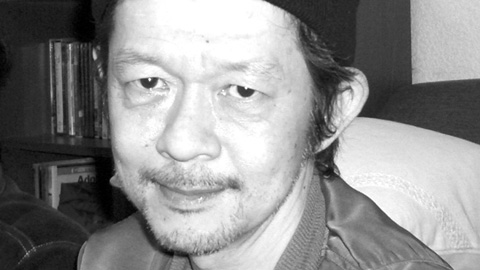
by Johannes Schönherr
Even for hardcore fans of Japanese underground movies, the name Shozin Fukui might not immediately ring a bell. This may have something to do with the fact that following the 1996 release of his claustrophobic, ultra-violent, high-speed brain-driller Rubber's Lover, Fukui dropped out of sight for more than 10 years.
But now he is back with a vengeance - not only have his old films been released on DVD in both the U.S. (through Unearthed Films) and Japan, but there's also his new all-out psycho-attack, The Hiding.
Originally a native of Hyogo Prefecture in Kansai, Fukui moved to Tokyo in the 1980s and quickly got involved with the punk underground movie scene there. In 1988, Fukui worked on Shinya Tsukamoto's Tetsuo: The Iron Man (1989), which quickly became the quintessential Japanese cyberpunk film - the melding of man and machine or rather, man and scrap iron, a profoundly body-oriented sci-fi nightmare. Imagine, shaving one morning and finding a piece of wire sticking out from your cheek... and that's just the start.
But unlike Tsukamoto, who kept on exploring the body in his following films, Fukui went for the even more dangerous matter - the grey matter. Already parallel to his involvement in Tetsuo, he shot a fairly disturbing 33-minute piece called Caterpillar (1988). But it was his debut feature Pinocchio √ 964 (1991) that made Fukui's name. The plot is easily recounted: Pinocchio was once a normal young man, until he got kidnapped by an evil corporation, brainwashed and transformed into a sex-slave cyborg for sale. He is picked up by Himiko, a waif-like girl living in an abandoned warehouse. They fall in love, Pinocchio regains his memory (well, sort of) and begins enacting his terrible revenge on the evil company employees that made him what he is.
It wasn't the plot that made the film a cult hit - it was the sheer madness playing out on screen. Himiko is crazy as hell, but wait til you see Pinocchio on his mad rampage through the streets of central Shinjuku and out into the wastelands, all the while chained to a steel pyramid, his mind tortured and driven in his quest for bloody vengeance.
If Pinocchio was already a nightmare full of mind-blowing scenes, Fukui's follow-up Rubber's Lover (1996) added the element of claustrophobia. A cruel experiment by mad scientists goes terribly wrong - and all the terror plays out in their tiny lab. Heads explode... but these are just one variant of minds acting out while in a mental pressure-cooker.
After that, even Fukui needed a decade of rest. But now he is back with The Hiding, his first digital work. The Hiding is 40 minutes long and tells of a hikikomori (social recluse) girl who is afraid of everything outside her door. But eventually, she has to get the garbage out. This is when strange and violent things begin to happen... or is it all just a fantasy of this lonely, scared girl?
Disturbing, though not as intense as Fukui's earlier works, The Hiding is a transitional film in Fukui's career, mainly serving to announce his return from a long absence. He already has his next film in the can, entitled S-94. Dealing with entirely different subject matter, S-94 might take Fukui to fresh and even scarier extremes. Besides his work in cinema, Fukui also runs a tiny bar named Kemuri in Tokyo's Higashi Nakano neighborhood. Johannes Schönherr met up with him there to talk about his career, his disappearance from the scene, his comeback, and his plans for the future.
First of all, I would like to talk a bit about the Japan of the 1980s and early 90s. Because I think it was kind of a special situation. Starting with Sogo Ishii's Crazy Thunder Road [1980], then going into the punk rock movies and eventually arriving at cyberpunk. There was a very close relation between musicians and filmmakers.
This is because the directors liked music a lot. Filmmakers asked their favorite musicians to work with them.
Many directors were musicians themselves. Like Shigeru Izumiya for example... [Note: Former 1970s folk / protest singer Izumiya directed the bizarre early cyberpunk entry Death Powder in 1986, strongly anticipating the direction the genre would later take with films like Tetsuo and Pinocchio √ 964.]
Yes, often musicians initiated movies. They made the soundtrack and acted in their own movies. A little later, musicians started to make their own movies. Many directors had their own bands. They were all influenced by Sogo Ishii, I think.
You worked with Sogo Ishii.
At first, I worked with Shinya Tsukamoto as assistant director on Tetsuo. But you couldn't say I was really an assistant director. I just helped out a little. Later I worked with Sogo Ishii as a real assistant director. The first Ishii movie I worked on was Master of Shiatsu, from 1989. That was a short film.
How did you get started making your own movies?
I liked movies and I also played in a band. This led me into working for a company that shot music promotion videos for noise bands at live shows. At the same time, I was already thinking about making my own movies. After being Ishii's assistant director, I just wanted to direct a movie by myself.
The oldest movie you made that's mentioned on your website is Metal Days (1986).
I shot that while I was a student. I made this movie with the members of my band and their friends.
Then came Gerorist, which is very much a punk film.
I shot that with the same people I made Metal Days with.
Gerorist (Gerorisuto, 1987, 12 mins, Super-8, color)
A true guerilla punk picture. A severely disturbed, seriously angry girl rides the Tokyo subway, aggressively moving from seat to seat, from car to car, sometimes rolling on the floor. Once in Shibuya, she attacks office workers on the street.
Gero means "upchucking" in Japanese slang, the title Gerorist therefore suggests that it is about somebody who terrorizes by excessive puking. This isn't exactly the case but there is copious puking in the movie.
Who was the girl in Gerorist?
Her name is Chiemi Endo. She was an actress from a theater group. I knew her and I asked her to act in my film. After that film she quit her acting career.
It must have been very hard for her to attack all those pedestrians. Where was it actually shot?
It was in Shibuya and in the subway. At the time we made the film, street performances started to become a fashion in Japan. People just expressed things on the street. That's why it was easy to shoot that film.
But I can imagine that a lot of the pedestrians became angry at her. They definitely look like it.
No, no. Quite the opposite. I just brought the pedestrians into my movie. We suddenly approached them, we certainly surprised them. But they were quite happy to be in the movie. They thought it was some sort of performance art.
After Gerorist you made Caterpillar...
Yes.
Caterpillar (1988, 33 mins, Super-8, color)
Shozin Fukui's most experimental and perhaps his most disturbing film. No plot except some early cyberpunk references being played out. Feels like a really bad LSD trip... which suddenly lets you in on how a true psychopath's mind works.
It has kind of two parts...
How so?
Well, in the first half, it's those lonely children running around an empty Tokyo, then the Caterpillar demolition excavator tears down a building while a punk song plays and then the action with the girl with the golden mask and the cyberpunk kids show up. So, the scene with the Caterpillar machine separates the part featuring the lost kids from the one where things get really crazy.
Yes, you could see it that way.
I especially like the first part. It's very strange... especially considering the sound effects.
I made all those sound effects myself. There was just a feeling of making music going into that part. It was purely an experiment.
Then, in the "second part" there is the girl with the golden mask who has that very strange and shrill laugh...
That laugh is my laugh which we put through a sound effects machine. We did the same thing with all the sounds in the movie.
Caterpillar feels very much like a kind of mental picture.
I would say that exploring extreme mental conditions is my subject matter. It's very difficult to explain with words. The mental part is beyond the physical part. Sometimes, the mental is stronger. That's what I'm curious about.
You can already see that with the girl acting out in Gerorist and later it gets more pronounced in Pinocchio √ 964 and Rubber's Lover. So basically, cyberpunk was about the body transforming into technology but in your case it's the head which transforms to another state.
The moment when the mind overwhelms the body is the most interesting to me. This moment is kind of psychic. My goal is to try to describe this moment. In this moment a new power erupts. This power I call psychic. For this moment to happen, requires a strong trigger, which could come from the body and mind being subjected to forceful technology. When the psychic power takes over it breaks through the physical limits. To describe that moment and process I use the images of puking.
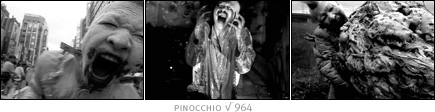
Pinocchio √ 964 (1991, 96 mins, 16mm, color)
Pinocchio was once human but he was kidnapped by an evil corporation which lobotomized him and transformed him into a sex-slave cyborg for sale. A lesbian couple, unsatisfied with his performance, kicks him out onto the street. He wanders aimlessly around till a homeless girl, Himiko, picks him up. They fall in love... and Pinocchio eventually regains his memory... kind of. His revenge on the evil company will be terrible. Himiko and Pinocchio are certainly among the craziest characters ever showing up in Japanese cinema. A fast, loud, and definitely mad movie.
Himiko got Pinocchio to reach the ultimate of that moment of mental breakthrough at the end of Pinocchio √ 964.
Yes, exactly.
You wrote the script for Pinocchio √ 964?
Yes, I did.
I like Himiko a lot.
At the beginning, that actress was a staff member. For a long time, I did auditions to find an actress. Finally, just before we started shooting, we decided to use her. I trained her for one week and then we started to shoot.
She's credited as Onn-chan. Was that her nickname?
We made that name up for the movie. After this movie, she never acted in another one again.
What's the name of the Pinocchio actor?
Hage Suzuki. After finishing the movie, he went back to his hometown and got married. His parents were farmers. He took over the farm.
The actors couldn't continue on after going through the intensity of the film?
Most actors quit all their involvement in film after Pinocchio √ 964. Basically, they were the members of my band, not actors. The band simply went through a period of filmmaking. For them, making music and performing in the film were basically the same thing. But after Pinocchio √ 964, they felt that they had completed their performance.
Pinocchio √ 964 looks very much like a movie shot guerrilla-style, especially Pinocchio's run through the streets of Shinjuku.
It was half guerrilla, half with permits. These days, you can't do real guerrilla shooting anymore. It's very strict now.
Only Adult Video does it nowadays.
(laughs)
You had to get permits for the subway, I suppose...
Yes, from the subway company, from the police, and so on.
But for the streets you didn't need any?
Even for shooting in the street I got permits.
You got a permit for filming Pinocchio's run through Shinjuku?
That was guerrilla style. It's more interesting to use guerrilla tactics when I get pedestrians into my movies. For those running scenes guerrilla is best. But for slowly walking, you need a permit, otherwise the police will show up quickly.
Any interesting stories on the guerrilla shooting?
The people in the stores in front of which we were shooting liked it and were interested in us. They invited us sometimes to eat with them. Because it was very rare that somebody would make movies in such an extreme way. They liked that. They may have considered it a kind of performance, I think.
The final scene of Pinocchio and Himiko's transformation reminds me a lot of the alien transformation scene at the end of Peter Jackson's Bad Taste (1987).
I like Peter Jackson's movie a lot. I saw Bad Taste after I made Pinocchio √ 964. I was very surprised but also very pleased when I watched it and I thought that there is someone in a totally different place doing the same things like I do.
Speaking about foreign films, were there any foreign films that influenced you in your work?
Blade Runner was a very important film for me. It was not very successful on its first run in Japan, my local movie theater showed it just for a week. I sat through all the shows during that one week, all afternoon and evening. Mostly, I was the only one sitting in the theater. I also saw Zombie a lot of times...
Which Zombie?
[Fukui looks through his DVDs on the shelf behind him, then holds up two boxes]
Ah, Dawn of the Dead (George Romero, 1978) and Day of the Dead (George Romero, 1985).
Also Night of the Living Dead. George Romero's zombie films... I watched them very carefully. I watched them before I went to bed and I could sleep very well after watching them (laughs).
Were there any connections to the American underground at all?
Hmm... I often watched Kenneth Anger's films. Scorpio Rising, for example.
What about Japanese films?
We didn't have this kind of movie in Japan. Basically, I only watched foreign films. But there was Kon Ichikawa's The Inugami Family (Inugamike no Ichizoku, 1976). The original version of the film. I saw this movie many times. With this movie I studied editing. I liked the editing in it.
Pinocchio √ 964 was shown at the Rotterdam Film Festival. Did you go there?
No, I didn't. By chance, a programmer from Rotterdam saw Pinocchio √ 964 in Japan. He liked it, so he quickly invited the film to Rotterdam.
So you don't know about the reaction of the audience over there.
Nothing at all. Later, I heard from this programmer that it went very well... He showed me a photo of the audience. That was cool.
Did Eirin ask for many cuts for the Japanese release of the film?
They checked the movie many times but they didn't cut anything. But I had to explain the scenes over and over again. Finally it got an R rating.
In Japan, in which kind of theaters did the movie play?
It played at the Nakano Musashino Hall in Tokyo, which doesn't exist anymore. Then, Nagoya, Osaka, Kyoto, Kyushu, maybe Hokkaido, I forgot the names of the theaters. It went to many places as a road show all over Japan.
How was the reaction of the Japanese audience?
Basically, the audience was not a film audience - more like a live music audience. They came to see an event. The style of the show was like a live concert. We took a PA into the theater. For example, these days many people go to see noise bands because they are rare. It was this kind of atmosphere. The places we showed the film were like live houses.
Pinocchio √ 964 got released in 1991. After that you started to work on Rubber's Lover?
Yes, right after Pinocchio √ 964, I started to prepare Rubber's Lover. That came out in 1996. I took me five years to make Rubber's Lover.

Rubber's Lover (1996, 96 mins, 16mm, black & white)
Psychic experimentation and physical destruction. A group of researchers tries in a lab to create a rubber suit which will cause the brain to go way beyond its limits. The experiments fail, the human guinea pigs cannot take the intensity of the experiments and simply turn crazy. The funds are running out. Beautiful secretary Kiku arrives to announce the termination of the experiments. Instead, she becomes the final guinea pig...
Rubber's Lover is very different from Pinocchio √ 964. Everything takes place inside a small room...
Pinocchio √ 964 was do (active), Rubber's Lover was sei (silent, static). From Rubber's Lover on, claustrophobia became my new subject matter. It was about being trapped.
It's also the very small group of actors which makes the movie very intense.
Yes, exactly. This feeling continues with the hikikomori in The Hiding.
I heard that during the shooting of Rubber's Lover, the crew was not allowed to talk.
Yes. Talking was prohibited. It was very silent. This way, the actors could feel very much separated. I think that it was very hard for staff and cast.
How about the special effects? They look very good.
I had two special effects artists working with me. In Pinocchio √ 964, it was different. On that one, the effects were done by the main actor and me alone.
After Rubber's Lover you were at the peak of your fame, but you very much dropped out of the picture...
After the theatrical release, the film had a video release. Then, I got a job at a video production company. I became interested in video work. For about 10 years I did work in video. I had no connections to film.
Did you also think that it was enough for the time being with the exploration of mental power?
Yes, I thought it's enough now and I wanted to do something new. Then I encountered video. That one decade was visual work just as a business. But I wrote many scripts in that time, which I showed to many film companies. Inversely, sometimes major production companies asked me for scripts but my scripts were always too extreme for them and couldn't get realized.
At that time, you also made the Psychic Image documentary...
That was company business. At the time, there was a genre called Original Video, which would now be V-Cinema. It was a part of my ten years in video.
At that time, you also made a documentary on the making of Isao Yukisada's Go.
That was also a part of my company work.
The Hiding was then the first movie that got you back into independent filmmaking.
At first I worked as an independent, then in business, now I want to go back to independence. I thought, if I make my own films, which field would be best? I decided that independent film is best for me.
The Hiding goes back to your old subject matter, to the mental issues...
I want to interpret genres like horror in a different way. I want to show new ways. I like horror movies a lot, I study horror, so it's not that I want to create a new genre. But I want to look at horror from a different angle.
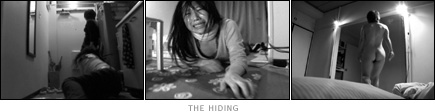
The Hiding (2008, 40 mins, digital, color)
Fukui's comeback film after a hiatus of more than 10 years. A hikikomori girl is afraid of everything outside her door. But finally, she has to get that garbage out. When she returns fromt eh garbage dump, a criminal woman pushes her way through her door. Strange and violent things begin to happen... or is all that just the fantasy of the lonely, scared girl?
In The Hiding, the main horror is in the head of the girl...
Yes, maybe unconsciously the root of my subject matter is the inside of the characters, their mental inner workings.
In an old interview 1, you talked about a movie you planned involving some virus.
I had planned to make that movie with a major company. But the contents were too extreme for them. I couldn't realize this movie with a major company. Now, I think that I must make it on my own.
That'll be your next big project?
I already started work on it. The film after The Hiding will be a prototype of my virus film. This next film already has a virus as subject matter. It's the first step in making the virus movie. I want to evolve this subject matter.
Nowadays, can you still find people who would be willing to act as crazy as the folks in Pinocchio √ 964?
Yes, there are still people like that. In the film after The Hiding, I already use this kind of people. S-94 is the name of that film. That's the name of the virus. It will appear in all upcoming movies. I have the same kind of people in there as in Pinocchio √ 964, and Rubber's Lover.
The virus is a virus that infects people? It's not a computer virus?
Yes, it is a disease-causing germ, it infects people. This virus changes the people's consciousness.
Did you see Kinji Fukasaku's film Virus from 1980?
Yes. That shows a virus in a very orthodox way. But I want to give a new interpretation. I want to make a new situation for the virus. My virus is also man-made. The scientists started out to create something for a totally different purpose but they accidentally make a new virus. But it's not a biological weapon like in the Fukasaku film. S-94 is part of an omnibus project. Many different directors have their short films in there. After that, I will show S-94 in theaters. I made two versions of S-94, a 30-minute and a 15-minute version.
What do you think, is it more difficult or easier to work in independent film today?
That depends on the person.
On the one hand, you got much cheaper technology now like DV but on the other hand there is no big underground scene anymore to support projects.
Today's indie situation is very interesting. In the past, you needed a big crew. Because we were using celluloid, the work was difficult. Now, one person can do all of that by himself. The first step in making a movie is very easy now. If you can establish yourself in making films and release them through DVDs, majors and indies can become equal. Of course, that includes the internet. On the other hand, unfortunately, the places where indies are shown go out of business. There are many cinema complexes now and they show only major movies. Theaters that show independent movies have become rare. Of course, many people have home theaters now and have the environment to see DVDs in their houses. They've got big screens, good sound equipment, they don't need to go to theaters. They can also download films from the internet. That's all very interesting.
Any final comments?
I already mentioned those ten years I spent away from the movie scene... I used to like analog music and images. In those ten years I started to get interested in digital things. I studied how to work with digital equipment. Now, this knowledge becomes the base of my current work.
1 Interview by Romain Slocombe, published in: Jack Hunter: Eros in Hell: Sex, Blood and Madness in Japanese Cinema. London: Creation Books, 1998.